Now online: 2025 CSR Annual Report
17 April 26
News

Are you interested in our chain concepts? Log in with your email address and password or contact our livestock team.
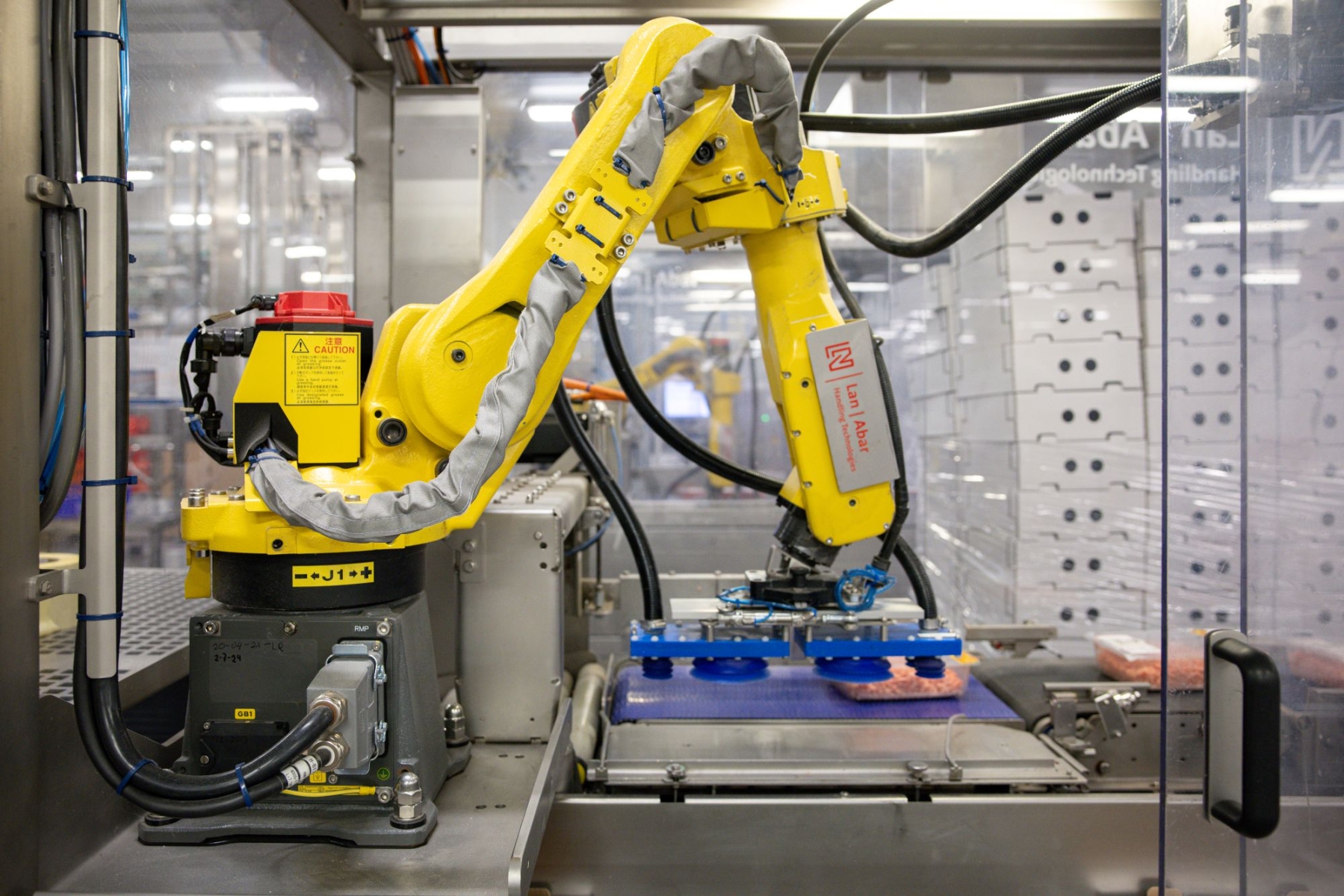
Last year, Van Loon Group sold over 1 million kilograms of plant-based proteins in hybrid meat products. This accounted for over 11 per cent of the total range and amounted to 11.3 million kilograms of finished product. Van Loon is therefore ahead of its own schedule, says Sander Krijnen, R&D manager at Van Loon Group, during the presentation of the CSR annual report. Is that a lot? Not in total terms yet: it is the equivalent of 2,000 pigs, 1,700 cattle and 40,000 chickens. But according to the food company, which mainly processes pork and beef and, to a lesser extent, poultry, the course towards hybrid meat has been set.
Krijnen carries out plenty of testing, but ultimately it is the consumer who decides. And meat with added plant-based proteins also meets with resistance. A retailer advertising hybrid meat sells 15 per cent less, as Krijnen demonstrates in a presentation. However, a meat product to which plant-based proteins have been added less explicitly actually sells better than the standard alternative. It is never more expensive than the conventional product and in many cases even cheaper.
According to the meat processor, taste must always be the guiding factor. And that works, adds CSO Roland van Loon. Test panels find hybrid beef and chicken products with a higher percentage of plant-based protein tastier than the conventional alternative. With pork products, higher percentages are more difficult to achieve, as the end product then becomes too soft in texture. “A high proportion is not an end in itself,” says Van Loon.
According to Van Loon, taste and price therefore favour the hybrid. So why do consumers buy less when the packaging explicitly states that it is a hybrid product? “Consumers don’t want to be patronised,” says Van Loon. “They become resistant when something is imposed on them.” In principle, nothing is being imposed at the moment, but according to the sustainability director, that is still the consumer’s perception. He sees it as a dilemma, but a change in taste simply takes time. He cites Coca-Cola as an example, which took years to establish Diet Coke. Or alcohol-free beer, which has only really taken off in recent years.
Krijnen is therefore not worried. In his view, consumer tastes cannot quite keep up with the technology yet. And he saw for himself, for example, that change takes time when it comes to the salt content in meat. When Krijnen started at Van Loon eighteen years ago, there was around 1.7 per cent salt in the meat products. “That’s now about half. Our taste buds weren’t ready for such a low salt content back then.”
What we’re doing is exactly the same as what the butcher used to do with his meatballs, only on a large scale
A gradual shift from animal to plant-based proteins helps to reduce the pressure on the environment and climate, Van Loon writes in the CSR annual report. But the hybrid meat rolling off the production line at the processor is quickly stigmatised as ‘highly processed food.’ Van Loon sees this as a dilemma too. After all, can you lump all processed food together? “In America, you have products containing lemon where, in the end product, hardly anything remains of the original lemon. That’s not the case here. What we do is exactly the same as what the butcher used to do with his meatballs, only on a larger scale. But now it’s suddenly called ‘processed food’.”
Supermarket chains have nevertheless committed to the protein transition and are demanding that Van Loon produce hybrid meat containing plant-based proteins. Van Loon sometimes even has to temper these requests, as taste must still be the guiding principle. Behind the scenes, however, the meat processor is investing in a larger facility to produce more plant-based fibres and is exploring options for using proteins other than field bean and pea protein. Hybrid is slowly becoming the norm.